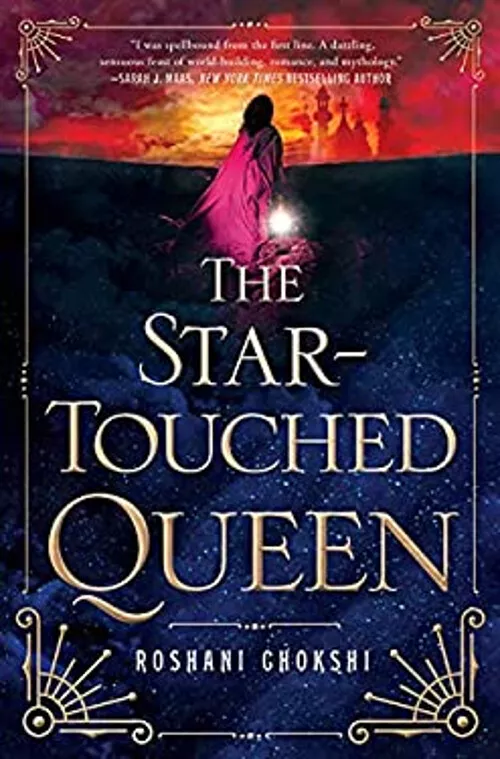
Written by Roshani Choksi, The Star Touched Queen is a beautiful and intricate story interwoven with multiple themes and symbolism that are relevant to the teachings of A Course in Miracles. It follows the story of a princess named Maya, born with a dark horoscope and scorned by her superstitious kingdom. Maya’s father, the Raja, arranges a swayamvara where unsuspecting suitors from other kingdoms come to vie for his daughter’s hand in marriage. But the event is a ploy designed to end in Maya’s death by poison, in the Raja’s attempt to bring peace to his war-stricken lands.
When a battle breaks out just as Maya is about to consume the poison, a mysterious man appears claiming to be a suitor and promising to whisk her to safety. Maya weds him and they flee the kingdom for his own lands, a place she has never heard of. This land is strange, full of magic and empty of all people except Maya, her new husband, Amar, and his servant. It is also full of secrets. Amar knows the truth about Maya’s real identity, which is not what she thinks it is. But she must wait for the new moon before these secrets can be revealed to her and her memories restored.
Under Amar’s instruction, Maya realises she has powers that she was unaware she possessed. As she develops these powers, she begins to have glimpses of other parts of herself – parts that represent who she really is. In the story, Amar could be seen to represent the Holy Spirit, whereas Maya is us – the fallen ones who have forgotten who we are. Just like Maya, we need help to remember. We need a guide that knows our true Self and can lead us back to it. The Holy Spirit is that guide;
He seems to be a Guide through a far country, for you need that form of help (M-C.6.4:6).
Maya’s powers can be seen to represent our own powerlessness that comes as a result of identifying with the small self that we think we are. While we continue to believe we are this false self, like Maya, our true powers will lay latent, waiting to be remembered under the Holy Spirit’s guidance. Just as Amar perceives the truth in Maya, the Holy Spirit, who is not fooled by our misperceptions of littleness about ourselves, sees only the truth in us. He overlooks the false images we have made in favour of our real strength, perceiving our inner power when we cannot. He holds the vision of our true Self steady for us until we are ready to remember it ourselves. Just as Maya takes time to adjust to and utilise her true potential, so too, does it take us time to accept that we are not really who we thought we were. The Holy Spirit guides us like Amar guides Maya, step by step, knowing that it is a process that happens gradually and gently, just like the coming of the new moon.
A major theme in the book is the tapestry that hangs in the throne room. This tapestry is alive, all the threads entwined with each other, and each thread representing the life of someone. Maya’s powers enable her to see the different options, the different threads of each person’s life, and it is up to her to choose which thread to pull, which destiny to fulfill for them. There are only so many paths available to each person, and some events are fixed. If she pulls one thread, one outcome will occur. If she pulls the other, it will result in a different outcome. Sometimes, no matter the thread that is pulled, there will be a fixed outcome that is unavoidable.
This fits in with the A Course in Miracles’ idea of the script. Like the threads in the tapestry, we each have our own scripts, our own stories that are playing out. Nothing is random or by chance;
The script is written (W-p1.158.4:3).
It appears we make many choices here, but it is all an illusion. Our choices are made on a different level- the level of the mind. The only meaningful choice we can really make is whose perspective we view the script of our lives with – the ego, or the Holy Spirit? Choosing with the ego will sometimes alter our threads and take us down one path, and choosing with the Holy Spirit may take us down another. Or sometimes it may be that the event is fixed and no matter which we choose we will experience a particular outcome anyway. The difference is in how we experience it. Do we experience it with the Holy Spirit’s peace, or the ego’s fear?
When Maya first attempts to pull the thread, it will not budge. She is unable to influence it because her powers are not yet strong enough. She hasn’t unlocked enough of her true identity to be able to access the inner strength required, and she doubts herself and her worthiness. It is the same with us. We play out our scripts mindlessly, automatically choosing the ego’s perspective and blindly following the paths it lays out for us. It is not until we begin to remember our identity as Spirit, and realise that we have another choice, that we are able to meaningfully alter our scripts. We do this by choosing against the ego’s perspective in favour of the Holy Spirit’s. This is the true ‘power’ that we possess. It is not magical powers such as those displayed in the story, but it is the power of our mind to choose again;
And so again we make the only choice that ever can be made; we choose between illusions and the truth, or pain and joy, or hell and Heaven (W-190.11:1).
As we go along and utilise our power to choose with the Holy Spirit more and more consistently, the threads of the ego’s script begin to unravel. Instead of pulling the threads that lead us into a deeper sleep, we instead choose to pull those that lead us closer to waking up.
While Maya waits for the new moon to reveal her true self, the palace whispers and spins illusions in her mind, making her question Amar’s intentions. It coaxes her through doors that are locked and barred and teases her with secrets and distorted memories of her true identity. It is in one of these rooms she meets Nritti, a soul she has vague memories of from past lives, who is trapped in a portal within a mirror. It is Nritti that has been weaving words of doubt and confusion in Maya’s mind. Nritti can be seen to represent the ego mind. The ego convinces us that it is our friend, that it is looking out for us, and it has our best interests at heart, but it fills our minds with illusions and veils our true reality from us. The ego seduces us with promises of specialness and individuality, and tells us that if we just trust it, it will take care of us.
Nritti is deperate to win Maya over to her side before the new moon, before she fully remembers who she is. She knows that the restoration of Maya’s memory will expose all her lies and deceits, and that once this occurs Maya will choose Amar over her. It is the same with the ego. Its goal is to keep our attention fixed on it, listening to the illusions it spins in our mind and believing in the little self is tells us that we are. The ego knows if we remember who we really are, symbolised in the story by reaching the new moon, then all its illusions will be exposed, and we will choose against it in favour of the Holy Spirit. Since the ego is nothing more than a belief we made up, to withdraw this belief will be its undoing;
Do not be afraid of the ego. It depends on your mind, and as you made it by believing in it, so you can dispel it by withdrawing belief from it. (T-7.VIII.5:1-2)
Like the ego seduces us, Nritti seduces Maya with her sweet appearance and convincing lies, and she falls under the spell off her false promises of friendship. Maya is tricked into running a dagger through the tree that holds all the memories of herself and releasing Nritti from the portal in the mirror. This is a very symbolic scene in the story. In this moment, Maya choses Nritti over Amar, the ego over the Holy Spirit, and illusion over truth. The consequences are instant and brutal. Amar loses all memories he has of Maya, and Nritti gains ultimate power over his kingdom. Maya is instantly banished and finds herself back in her own world. She is standing upon cremation grounds, surrounded everywhere by death and destruction. Where before she was adorned with beautiful clothes and jewellery, she now wears the garments of a Sadhvi woman – a religious ascetic that renounces all identity and possessions. She has gone from being a queen and ruler, to being nobody and nothing, a wandering ghost without a home.
This part of the tale can be seen to represent the moment when we, as the one mind, chose to believe the stories of the ego over the truth of the Holy Spirit. It was the moment when we took the tiny, mad idea (T-27.VIII.6:2) seriously, and the consequences were just as brutal. It appeared we were ‘thrown out’ of the home that we knew, finding ourselves in the ego’s alien world of individuality and separation. But there was no ‘other’ who evicted us;
The secret of salvation is but this: that you are doing this unto yourself (T-27.VIII.10:1).
The ego was not the cause for our banishment, rather it was the decision to believe in it. By choosing to listen to the ego’s lies, it was us who gave up all our power, removing ourselves from our throne and placing the ego on it instead. Similarly, if Maya had chosen not to believe Nritti’s lies, her banishment would have never occurred.
It is now that Maya realises just what she has done. She can see how she was tricked and realises the error in judgement she has made. While she still cannot remember who she is, Maya can see she placed her faith in the wrong person, and she is determined to set it right and find out the truth. This reflects the turning point we all one day reach where we start to question the validity of the lives we are experiencing;
Eventually everyone begins to recognize, however dimly, that there must be a better way (T-2.III.3:6).
This is the start of our search for answers, for truth, and ultimately for a way back home. This is exactly what Maya does, she starts the search for a way back into Amar’s kingdom.
It is now that various companions show up in Maya’s life to help her along the way. These include a demon in the form of a dead horse, and an ocean elephant. These companions help Maya on her journey; indeed, she could not go on without their assistance. They can be seen to represent the guides, the helpers that show up in our lives when we are finally ready to begin the journey back to ourselves;
Yet when he is ready to go on, he goes with mighty companions beside him. Now he rests a while, and gathers them before going on. He will not go on from here alone (M-4.I-A.6:11-13).
Maya has reached the point where she is resolute in returning to Amar, in returning to her true Self, and with the birthing of this new commitment, the help she needs begins to appear along the way.
Before she begins, Maya decides she must first return to her old home and put to rest the ghosts of her past. Here she is given the opportunity to find closure with those she left behind and make peace with others whom she felt had wronged her. This is often a helpful part of the awakening journey – the process of confronting past hurts and choosing to perceive them differently. Where before we had chosen the ego, we now apply the power to change our mind and instead perceive with the Holy Spirit;
Trials are but lessons that you failed to learn presented once again, so where you made a faulty choice before you now can make a better one, and thus escape all pain that what you chose before has brought to you (T-31.VIII.3:1).
As we apply the Course’s form of forgiveness to the past upsets that still haunt us, as we remove the hidden layers of guilt, our memory of our true Self gradually and naturally becomes more available to us.
When Maya has completed this stage of her journey and has found her way back to Amar’s kingdom, she now must find a way to break the spell that Nritti has over him and take back her place as rightful queen. The only way to do this is to unlock her powers by remembering the truth that lies within her. When she is once again faced with the tapestry, instead of shrinking away from it, Maya uses all her inner strength and courage to let the tapestry consume her. Previously she could not bring herself to surrender to this, but she is not the same person she was before. Her journey and commitment to the truth has now prepared her for the memories of her true self to be restored. As the book so beautifully puts it – It was time. Time to leave this limbo. Time to embrace the light that was neither banished nor tainted, but buried deep within me, waiting until I could claim it once more (p.328).
Like Maya, we need preparation before the memory of who we really are can be restored to us. Our identity, as we see and experience it, is so completely and totally alien to our true nature as Spirit, that we need to be reintroduced to it gently;
So fearful is the dream, so seeming real, he could not waken to reality without the sweat of terror and a scream of mortal fear, unless a gentler dream preceded his awaking, and allowed his calmer mind to welcome, not to fear, the Voice that calls with love to waken him; a gentler dream, in which his suffering was healed and where his brother was his friend (T-27.VII.13:4).
With her merging with the tapestry, Maya’s memories come flooding back to her, and she finally remembers who she is. She can see how Nritti has tricked and deceived her over and over in past lives, and how by believing and trusting her, Maya has found herself in the position she is in.
But regaining her memory is not the last step. Maya still needs to finally bring an end to Nritti’s hold over her. She must side with the truth in her once and for all and fully withdraw belief in all of Nritti’s lies. Maya makes her choice for the last time – she chooses her true Self, renouncing all belief in any other identity that she thought she ever was. She is now able to command the threads on the tapestry. Finding her own thread, which is fatefully interwoven with Nritti’s, she removes it from the tapestry and instantly unlocks all her latent powers. Just like with us, once we fully remember who we are, we no longer need any more scripts. We wake up from the idea of scripts, of threads altogether, and lay our stories aside, instead choosing for the truth in us. Once we remember who we are, once we remember the truth of our Spirit and we see the ego’s illusions for what they are, we also still have one final choice to make. This is the choice to return to our true original state and end the dream once and for all. It is the choice to return our mind back home to its Source.
Now Maya is returned to her rightful place on the throne alongside Amar, as his equal. The whole time Amar knew that Maya’s true identity was as powerful and influential as his own, and it was this truth that he was guiding her back to. Now there are no differences between them. The Holy Spirit guides us in the same way. He knows that in our original state we are exactly and completely the same as him, for in truth the Holy Spirit is us – he is our Higher Self. When we remember this we will be his equal, exactly the same.
When Amar asks Maya how they should deal with Nritti and the chaos she has brought to their kingdom, Maya simply responds with, “Restore the light.” This so beautifully symbolises how the story of the ego ends. Not through force or hard-won victory, but merely by allowing the light of truth to shine away all the illusions that ever were. Then all that remains is the light of truth. And so, our own story one day ends; Child of peace, the light has come to you (T-22.VI.6:1).